Palsgraf Day
a story about proximate cause

I learned tort law from Ekow Yankah. He was an excellent professor, as long as you knew not to be late to class. Back in my first semester of law school, he was exciting: he wore suits, he knew philosophy, and I could listen to his voice lecture about Vosburg and Putney all day long.
(In case you’re wondering, this article is not about his suits. I’m going to be teaching you some tort law now. Deal with it).
And the case that excited him most, the one that he spent a majority of the semester hyping us up for, was Palsgraf. Every class, some way or another, he would bring up Palsgraf Day like it was the coming of the messiah. It would change our lives.
While criminal law deals with wrongs people commit against society—things like murder and embezzlement that cannot be allowed to continue in a just state—tort law deals with wrongs people commit against one another. Unsurprisingly, these often line up with crimes. Assault, battery (we learned the old-fashioned legal distinction between the concepts), intentional infliction of emotional distress, and various forms of negligence.
A tort involves four key elements: a duty owed by the defendant, breach of said duty, some legally cognizable harm, and a causal link from that breach to that harm. So: I have a duty not to punch you. If I punch you, I breach the duty. If I break your nose, you are harmed. And you were harmed because I violated my duty to not punch you. We not only owe each other a duty to not commit intentional torts, but a general duty of reasonable care, the failing of which we refer to as negligence. But the causal link… that’s a mysterious, metaphysical line that is subject to endless debate.
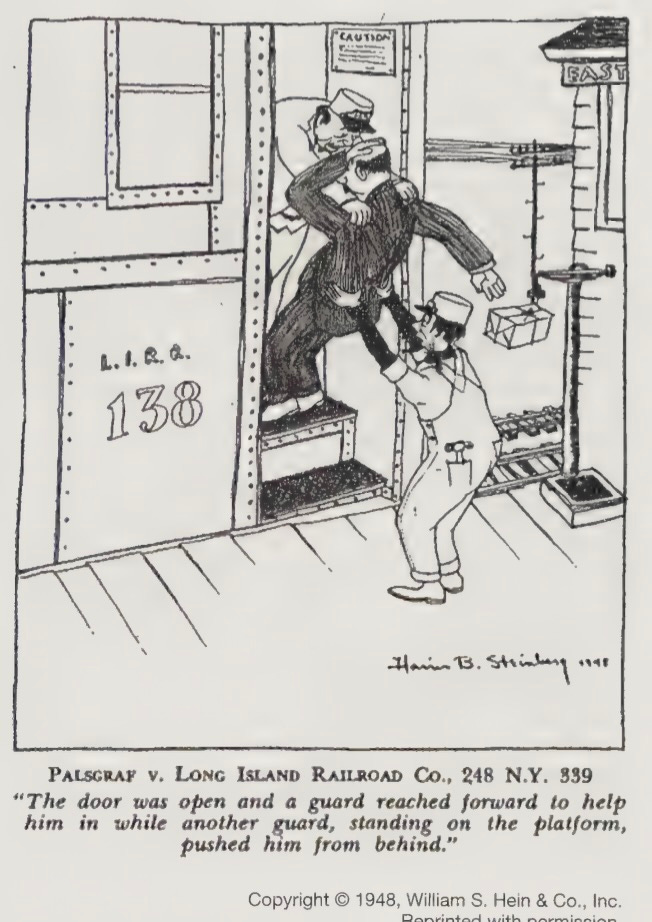
Palsgraf v. Long Island Railroad Co., 248 N.Y. 339, 162 N.E. 99 (1928), is a pretty famous case in legal circles. It hinges on a strange causal chain: Helen Palsgraf was waiting for her train on the Atlantic Avenue platform, near a large coin-operated novelty scale. Another train stopped at the station, and then began to pull away. But it pulled away before the doors could close, and a couple of gentlemen ran to catch it. They were carrying a package of fireworks, wrapped, poorly, in some newspaper. As an LIRR employee pushed him onto the train, the second man dropped the package, and the resulting explosion caused the scale to fall over and injure Mrs. Palsgraf.
Written by my law school’s namesake, the majority opinion argues that the LIRR’s failure to close the door was not a proximate cause of the injury, only a cause-in-fact.
That is to say, while Helen would not have been injured should the doors have closed properly, it seems very strange to actually connect the two events. The injury could not have reasonably been foreseen from the LIRR’s negligence. She was not within the “radius of danger” created by the doors remaining open, or by the employee pushing the man onto the train. Meaningfully, the real cause was the two men who were running around with a haphazardly-bound package of fireworks. Why, then, blame the LIRR?
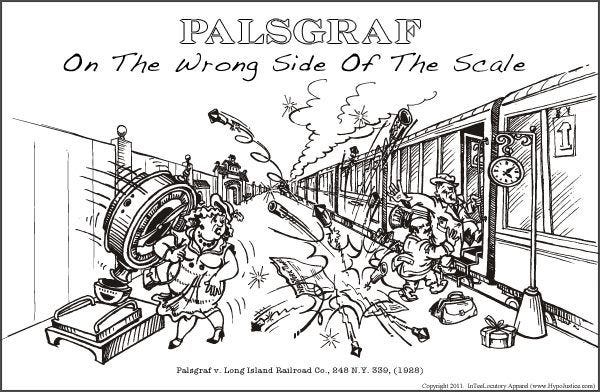
Andrews wrote for the dissent, arguing a slightly different standard. He argued that the duty of care we owe to one another is broad, and we should be responsible for the results of that care, even if they occur outside that “radius of danger.” The breach and the harm here were no mere coincidence; they happened at the same time, in around the same place. The sequence of events was natural and continuous and not too hard to explain. He argued, thus, that Palsgraf’s injuries were the proximate result of the breach in question.
The case was decided 4-3 at the highest court in the state of New York, the Court of Appeals. The nuance in each opinion has been debated ever since, serving as one of the rare cases where the dissent is considered about as compelling as the majority. These jurists made history with their work on the Court of Appeals, and Chief Judge Benjamin N. Cardozo soon made history again, becoming the first Jewish Justice on the supreme court (and technically the first Hispanic justice, but nobody really counts him, that honor goes to my favorite of the court’s current Justices, Sonia Sotomayor).
I wore a suit on Palsgraf day. I don’t think I wore it for Palsgraf day, but I can’t quite remember. In any event, professor Yankah called on me to go over the majority opinion, and, of course, knowing the importance of this case, I had actually read it! I hoped he’d even keep with me for the dissent, but alas, he wanted to spread the love and joy that was this discussion.